Every non-metallic gasket starts as a flat sheet of sealing material — rubber, PTFE, graphite, non-asbestos fiber, or silicone — and must be cut to a precise shape before it can seal anything. For decades, the standard method was die cutting: a steel rule die or punch die pressed through the material to produce the gasket shape. The die works, but it costs money to make, takes weeks to deliver, and becomes scrap the moment the design changes.
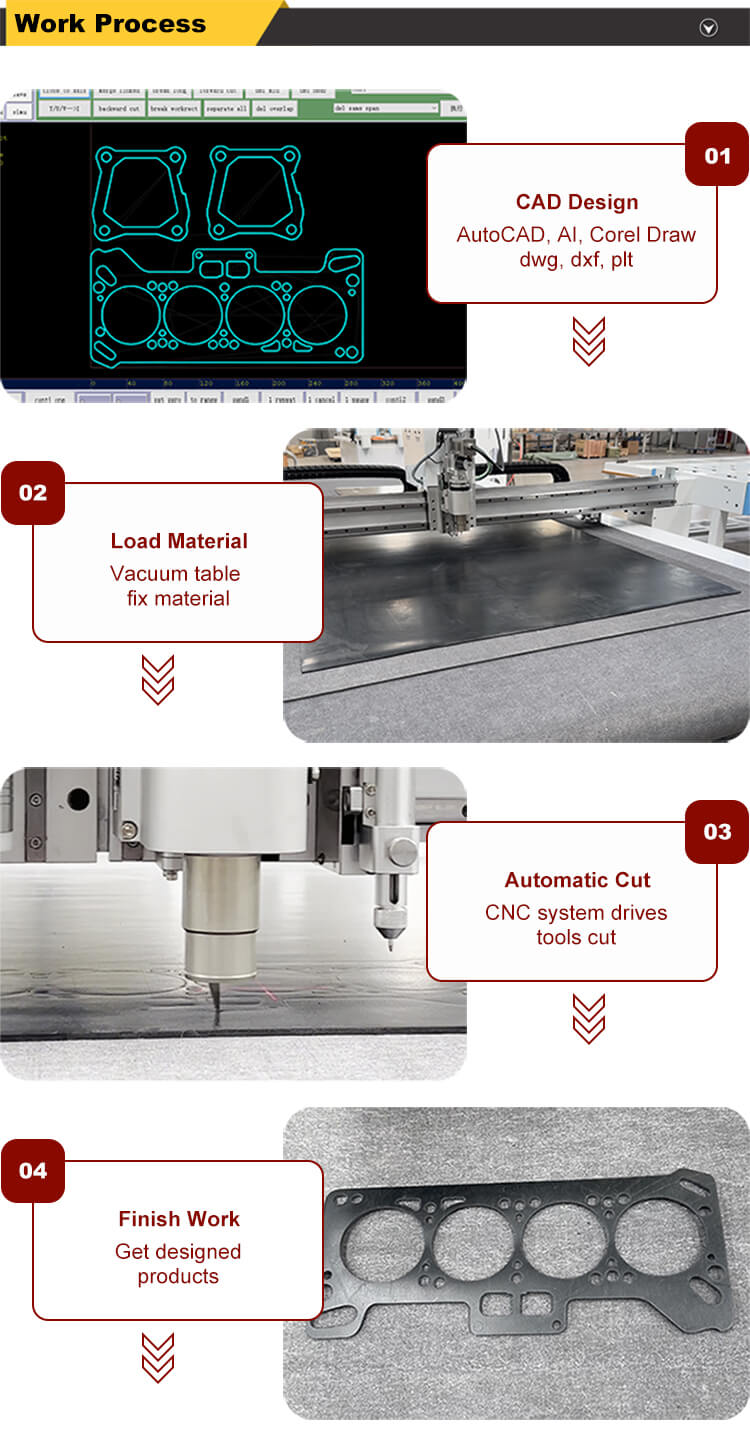
CNC gasket cutting eliminates the die entirely. A CNC gasket cutting machine reads a CAD drawing directly and cuts the gasket shape from the sheet material with high accuracy — no tooling cost, no lead time for new designs, no die inventory to manage. When a customer needs a non-standard gasket size, a replacement for an obsolete part, or a prototype for a new application, the answer is a DXF file and a cutting machine, not a die order.
This guide covers the complete picture: why different gasket materials require different cutting approaches, how the die-less CNC workflow operates from CAD to finished gasket, how to select the right machine for your materials and production volume, and how to calculate the economic case for switching from die cutting to CNC.
The Four Main Non-Metallic Gasket Materials — and Why Each Is Different
Non-metallic gaskets are not a single material category. Rubber, PTFE, graphite, and non-asbestos fiber sheets have fundamentally different mechanical properties, and those differences determine how each material must be cut to achieve clean edges, dimensional accuracy, and a reliable seal.
Rubber and Silicone Gaskets
Material characteristics: Rubber is elastic — it deforms under cutting force and recovers after the blade passes. This elasticity is the defining challenge of rubber cutting. A cutting tool that applies excessive lateral force will deflect the rubber rather than sever it, producing a cut edge that is not perpendicular to the sheet surface (a beveled or angled edge). When the rubber recovers after cutting, the edge springs back to an angle, and the gasket dimension is smaller than programmed.
Common rubber types for gaskets:
Natural rubber (NR): general-purpose sealing, good flexibility
EPDM: excellent weather, ozone, and steam resistance — common in HVAC and water treatment
Neoprene (CR): oil and chemical resistance — common in industrial equipment
Nitrile (NBR): petroleum and oil resistance — common in automotive and hydraulic applications
Viton (FKM): extreme chemical and temperature resistance — oil & gas, chemical processing
Cutting requirements:
Sharp blade with minimal lateral force — oscillating knife is preferred over drag knife for thick rubber
For roll materials: auto-feeding conveyor to enable continuous cutting without manual sheet handling
Vacuum hold-down calibrated to rubber thickness — thin rubber sheets can lift during cutting
Typical gasket applications: Pipe flange seals, pump and valve gaskets, automotive engine gaskets, HVAC duct seals, water treatment equipment
PTFE (Polytetrafluoroethylene) Gaskets
Material characteristics: PTFE is the opposite of rubber in almost every mechanical property. It is rigid (low elasticity), chemically inert, and extremely slippery (low friction coefficient). PTFE is also significantly harder than rubber, which means it is more abrasive to cutting blades. The low friction surface makes vacuum hold-down less effective than on rubber — PTFE sheets can slide on the cutting table if vacuum pressure is insufficient.
The critical cutting challenge with PTFE is dimensional accuracy under cutting force. PTFE does not deform and recover like rubber — if the blade applies lateral force that deflects the cut path, the error is permanent. PTFE gaskets for chemical and pharmaceutical applications are often specified to tight tolerances (±0.1–0.2mm) because the gasket must fit precisely in a machined groove or flange face.
Common PTFE gasket types:
Virgin PTFE sheet: pure PTFE, maximum chemical resistance
Filled PTFE: PTFE with glass, carbon, or bronze filler for improved mechanical properties
Expanded PTFE (ePTFE): softer, more compressible — used where low bolt load is required
PTFE envelope gaskets: PTFE enclosing a rubber or fiber core
Cutting requirements:
Sharp blade with correct geometry — PTFE is abrasive and dulls blades faster than rubber
High vacuum hold-down to prevent sheet sliding on the low-friction PTFE surface
Reduced cutting speed compared to rubber — PTFE's rigidity means cutting force is higher
Blade replacement at shorter intervals than for rubber
Typical gasket applications: Chemical reactor flanges, pharmaceutical process equipment, food processing pipelines, semiconductor manufacturing, cryogenic applications
Graphite Sheet Gaskets
Material characteristics: Flexible graphite sheet (also called expanded graphite or exfoliated graphite) is a unique material — it is soft and compressible like rubber but has completely different cutting behavior. Graphite sheet is brittle and friable: it breaks rather than deforms under excessive force, and the cut edge can crumble if the cutting action is not clean and controlled.
Graphite sheet is also extremely dusty to cut. Graphite particles are fine, black, and pervasive — they contaminate everything in the cutting area. Dust management is not optional when cutting graphite; it is a production and safety requirement.
Common graphite gasket types:
Pure flexible graphite sheet: maximum temperature resistance (up to 450°C in oxidizing atmospheres, higher in inert atmospheres)
Graphite sheet with stainless steel insert: improved mechanical strength for high-pressure applications
Graphite sheet with tanged metal insert: for extreme pressure and temperature
Cutting requirements:
Very sharp blade with minimal cutting force — graphite's brittleness means any excess force crumbles the cut edge
Low cutting speed for clean edge quality — graphite does not tolerate aggressive cutting
Dust extraction system — graphite dust is a contamination and respiratory hazard
Flatbed cutting (not conveyor) — graphite sheet is typically supplied in fixed sheets, not rolls
Nesting software to maximize yield — graphite sheet is expensive and waste is costly
Typical gasket applications: High-temperature pipe flanges, steam systems, exhaust systems, chemical processing at elevated temperatures, power generation equipment
Non-Asbestos Fiber (NAF) Compressed Sheet Gaskets
Material characteristics: Non-asbestos fiber sheet (also called compressed fiber sheet or CAF — compressed asbestos-free) is a composite material: aramid, glass, or carbon fibers bound with a rubber or elastomeric binder and compressed into a dense sheet. It is harder and more abrasive than rubber but less brittle than graphite.
Non-asbestos sheet is the most common replacement for traditional asbestos sheet gaskets in industrial applications. It is supplied in large sheets (typically 1500×1500mm or larger) and cut to the required gasket shape. Large-format cutting capability is important for NAF sheet gaskets — many industrial flanges require large gaskets that cannot be cut from small sheets.
Cutting requirements:
Sharp blade with moderate cutting force — NAF sheet is denser than rubber but not brittle like graphite
Large cutting table for full-size NAF sheets (up to 1600×2500mm)
Dust extraction recommended — fiber particles from NAF cutting are a respiratory concern
Nesting software for large sheets — maximizing yield on expensive NAF sheet reduces material cost significantly
Typical gasket applications: Industrial pipe flanges, pressure vessels, heat exchangers, boiler equipment, oil & gas process equipment
The Die-Less CNC Cutting Workflow: From CAD to Finished Gasket
The fundamental difference between die cutting and CNC cutting is not just the absence of a die — it is a complete change in the production workflow. Understanding the CNC workflow makes the economic and operational advantages concrete.
Traditional Die Cutting Workflow
Design change → Commission die maker → Wait 2–4 weeks → Receive die
→ Mount die on press → Set up press → Cut gaskets → Inspect
→ Store die (or scrap if design changes)
Total lead time for a new gasket design: 2–4 weeks minimum
Cost for a new die:
3,000 depending on complexity and size
Design change cost: Full die cost again, plus scrapping the old die
Die inventory: Physical storage required for every active design
Total lead time for a new gasket design: 15–30 minutes (import file, set up nesting, first cut)
Cost for a new design: Zero — the "tool" is a digital file
Design change cost: Zero — edit the DXF file and re-cut
Design storage: Digital file library, no physical storage
The Nesting Step: Where Material Savings Happen
The nesting step — arranging gasket patterns on the sheet material to minimize waste — is where CNC cutting delivers its most significant material savings compared to die cutting.
Die cutting nests patterns based on the fixed geometry of the die. The die layout is optimized once at the time of die manufacture and cannot be changed. If the sheet has a defect, the die cannot avoid it — the defective area is either cut through (producing a defective gasket) or wasted.
CNC nesting software arranges patterns dynamically for each sheet:
Automatic nesting: The software calculates the optimal arrangement of all required gasket shapes on the sheet, minimizing the gap between parts and maximizing the number of gaskets per sheet.
Mixed nesting: Different gasket designs can be nested together on the same sheet — useful for small-batch orders of multiple part numbers.
Defect avoidance: For materials with visible defects (inclusions, surface damage), the operator can mark defect areas in the software and the nesting algorithm automatically avoids placing gasket patterns over those areas.
For expensive materials like PTFE and graphite sheet, nesting optimization typically improves material utilization by 10–20% compared to die cutting. On a material that costs
200 per sheet, this is a significant annual saving at production volumes.
Material-Specific Cutting Parameters
Each gasket material requires different cutting parameters to achieve clean edges and dimensional accuracy. The following parameters are starting points — optimize for your specific material grade, thickness, and required edge quality.
Rubber and Silicone Cutting Parameters
Parameter
Thin Rubber (≤3mm)
Medium Rubber (3–10mm)
Thick Rubber (10–25mm)
Blade type
Straight oscillating
Straight oscillating
Straight oscillating (longer blade)
Oscillation frequency
High (15,000–20,000 spm)
High
Medium-high (12,000–18,000 spm)
Cutting speed
600–1,000 mm/min
400–700 mm/min
250–450 mm/min
Vacuum pressure
Standard (0.05–0.07 MPa)
Standard to high
High (0.07–0.09 MPa)
Blade life
15–25 hours
10–20 hours
8–15 hours
Key parameter note for rubber: Cutting speed has a larger effect on edge quality for rubber than for any other gasket material. Too fast produces a beveled edge (rubber deflects before cutting); too slow produces a compressed edge (rubber is compressed against the table). Find the speed that produces a clean, perpendicular cut edge and document it for each rubber grade.
PTFE Cutting Parameters
Parameter
Thin PTFE (≤3mm)
Medium PTFE (3–8mm)
Thick/Filled PTFE (8–20mm)
Blade type
Straight oscillating
Straight oscillating
Straight oscillating (reinforced)
Oscillation frequency
High (15,000–20,000 spm)
High
High
Cutting speed
400–700 mm/min
300–500 mm/min
200–350 mm/min
Vacuum pressure
High (0.07–0.09 MPa)
High
High
Blade life
6–12 hours
5–10 hours
4–8 hours
Key parameter note for PTFE: PTFE's low friction surface requires higher vacuum pressure than rubber. Verify hold-down by attempting to slide the sheet by hand after vacuum is applied — it should not move. If the sheet slides, increase vacuum pressure or clean the table surface (debris reduces effective vacuum area).
Graphite Sheet Cutting Parameters
Parameter
Standard Graphite (0.5–2mm)
Reinforced Graphite (with metal insert)
Blade type
Straight oscillating (sharp, fine edge)
Straight oscillating (heavier duty)
Oscillation frequency
Medium (10,000–15,000 spm)
Medium
Cutting speed
200–400 mm/min
150–300 mm/min
Vacuum pressure
Standard (0.05–0.07 MPa)
Standard to high
Blade life
8–16 hours
5–10 hours
Key parameter note for graphite: Lower oscillation frequency and slower cutting speed are counterintuitive for graphite — it is a thin, soft material. The reason is graphite's brittleness: high-frequency, high-speed cutting generates vibration that crumbles the cut edge. Slow, controlled cutting produces clean edges. Always use dust extraction when cutting graphite.
Non-Asbestos Fiber Sheet Cutting Parameters
Parameter
Standard NAF Sheet (1–3mm)
Heavy NAF Sheet (3–6mm)
Blade type
Straight oscillating
Straight oscillating (reinforced)
Oscillation frequency
High (15,000–20,000 spm)
High
Cutting speed
350–600 mm/min
250–400 mm/min
Vacuum pressure
Standard to high
High
Blade life
8–15 hours
5–10 hours
Choosing the Right CNC Gasket Cutting Machine
Shilai offers five CNC gasket cutting machine models, each optimized for specific materials, sheet formats, and production volumes. Selecting the right model depends on three factors: your primary material type, your sheet or roll format, and your daily production volume.
Selection Guide: Match Machine to Material and Format
Your Primary Material
Your Format
Recommended Model
Graphite, PTFE, small sheets
Sheet (≤600×900mm)
SL6090FG
PTFE, rubber, non-asbestos
Sheet (medium, ≤1600×1000mm)
SL1610FG
Non-asbestos, asbestos, large sheets
Sheet (large, ≤1600×2500mm)
SL1625FG
Rubber, silicone
Roll material
SL1610CG
Any material, high volume
Sheet or roll
SL1625FGD (dual-head)
SL6090FG Graphite Gasket Cutting Machine
Best for: Graphite sheet, PTFE, rubber — small sheets, custom orders, sampling, prototyping
The SL6090FG is the entry-level CNC gasket cutter for operations that primarily cut small sheets or need a dedicated machine for custom and prototype gaskets. Its compact 600×900mm cutting area handles standard small-format graphite and PTFE sheets efficiently.
Key specifications:
Cutting area: 600×900mm
Cutting accuracy: ±0.1mm
Cutting method: oscillating knife
Drive system: Japanese servo motors, Taiwan linear guide rails
Software: professional nesting software included
Warranty: 3 years
Ideal use case: A seal manufacturer that produces custom graphite gaskets for maintenance and repair orders — each order is a different size, quantities are small (5–50 pieces), and lead time is critical. The SL6090FG cuts any gasket shape from a DXF file in minutes, with no die cost and no waiting.
Best for: PTFE sheet, rubber sheet, non-asbestos sheet — medium format, prototyping to stable production
The SL1610FG handles medium-format sheets up to 1600×1000mm — the standard size for most PTFE and rubber gasket sheet suppliers. It is the most versatile model for operations that cut multiple non-metallic gasket materials on a single machine.
Key specifications:
Cutting area: 1600×1000mm
Cutting accuracy: ±0.1mm
Cutting method: oscillating knife
Drive system: Japanese servo motors, Taiwan linear guide rails
Software: professional nesting software with mixed-material nesting
Warranty: 3 years
Ideal use case: An industrial seal distributor that stocks PTFE, rubber, and non-asbestos sheet and cuts gaskets to order for customers in chemical, food processing, and water treatment industries. The SL1610FG handles all three materials on one machine, with no die investment for any gasket design.
Best for: Non-asbestos compressed sheet, asbestos sheet, large industrial flange gaskets — oil & gas, chemical, power generation
The SL1625FG is the large-format model, with a 1600×2500mm cutting area that accommodates full-size non-asbestos and asbestos sheets without repositioning. This is the correct machine for industrial gasket manufacturers supplying large flange gaskets to oil & gas, petrochemical, and power generation customers.
Key specifications:
Cutting area: 1600×2500mm
Cutting accuracy: ±0.1mm
Cutting method: oscillating knife
Drive system: Japanese servo motors, Taiwan linear guide rails
Dust-controlled cutting for asbestos and fiber materials
Warranty: 3 years
Ideal use case: A gasket manufacturer supplying large heat exchanger gaskets, pressure vessel flange gaskets, and boiler gaskets to industrial customers. Full-size sheets are cut in a single setup, with nesting software maximizing yield from expensive non-asbestos sheet.
Best for: Rubber roll, silicone roll, EPDM roll — continuous production, repeat orders, high-volume rubber gaskets
The SL1610CG is the roll-material specialist. Its conveyor belt auto-feed system advances rubber or silicone roll material automatically, enabling continuous cutting without stopping to reload sheets. This is the correct machine for operations that cut large volumes of rubber gaskets from roll stock.
Key specifications:
Cutting area: 1600×1000mm (per pass, continuous with auto-feed)
Cutting accuracy: ±0.1mm
Cutting method: oscillating knife
Auto-feed: conveyor belt for roll materials
Drive system: Japanese servo motors, Taiwan linear guide rails
Warranty: 3 years
Ideal use case: A rubber gasket manufacturer producing high volumes of pipe flange gaskets, pump gaskets, and valve gaskets from EPDM and nitrile rubber rolls. The auto-feed system enables one operator to run continuous production with minimal intervention.
Best for: High-volume production of any gasket material — graphite, PTFE, rubber, non-asbestos
The SL1625FGD is the high-productivity model. Two independent oscillating knife heads work simultaneously on the same sheet, effectively doubling output compared to a single-head machine with the same footprint. This is the correct machine for gasket manufacturers with high daily output requirements.
Drive system: Japanese servo motors, Taiwan linear guide rails
Software: dual-head nesting optimization
Warranty: 3 years
Ideal use case: A gasket manufacturer supplying industrial customers with daily orders of 500–2,000+ gaskets across multiple materials and designs. The dual-head system doubles throughput without doubling floor space or operator headcount.
The Economics: CNC vs. Die Cutting for Gasket Manufacturing
The decision to switch from die cutting to CNC is an economic calculation. The inputs are your current die costs, your material waste rate, and the value of your production flexibility. Here is how the calculation works for a typical gasket manufacturer.
Scenario: Mid-Size Industrial Gasket Manufacturer
Current situation:
80 active gasket designs across rubber, PTFE, and non-asbestos materials
Average die cost: $800 per design
Die inventory value: $64,000
New design requests per month: 6–8 (each requiring a new die)
Monthly die cost:
6,400
Material utilization with die cutting: ~72% (28% waste)
Monthly material spend: $15,000
Monthly material waste cost: $4,200
With CNC cutting:
Machine investment:
35,000 (depending on model)
Monthly die cost: $0
Material utilization with CNC nesting: ~85% (15% waste)
Monthly material waste cost: $2,250
Monthly material savings: $1,950
Monthly savings from eliminating dies:
6,400
Monthly savings from reduced material waste: $1,950
Total monthly savings:
8,350
Payback period: 2–5 months
This calculation does not include the value of faster response to new design requests (from 2–4 weeks to same-day), the elimination of die storage space, or the ability to accept small-batch custom orders that were previously uneconomical with die tooling costs.
From Manual Cutting to CNC: What the Transition Looks Like
Many gasket manufacturers currently cut gaskets manually — using hand knives, scissors, or manual punch presses with simple templates. The transition to CNC cutting is straightforward, but it requires understanding what changes in the production process.
What changes:
Pattern creation moves from physical templates to DXF files (most gasket designs can be drawn in any CAD software in 10–30 minutes)
Material loading changes from manual positioning to placing sheets on the cutting table and activating vacuum
Cutting changes from manual knife work to pressing "start" on the CNC controller
Quality control becomes simpler — CNC cuts are consistent, so inspection focuses on verifying the first part rather than checking every part
What does not change:
Material sourcing — the same rubber, PTFE, and graphite sheet suppliers
Downstream processing — gaskets still go through the same inspection, packaging, and shipping steps
Customer specifications — the gasket dimensions and tolerances remain the same
The learning curve: Most operators can produce their first production-quality CNC gaskets within 1–2 days of training. Shilai provides on-site installation and training for all machines, and lifetime technical support for software and parameter questions.
Conclusion
CNC gasket cutting is not a technology upgrade — it is a business model upgrade. By eliminating die tooling costs, reducing material waste through intelligent nesting, and enabling same-day response to new design requests, CNC cutting transforms gasket manufacturing from a capital-intensive, lead-time-constrained operation into a flexible, low-overhead production system.
The technology is proven: Shilai's CNC gasket cutting machines are operating in gasket manufacturing facilities across more than 100 countries, cutting rubber, PTFE, graphite, and non-asbestos materials to ±0.1mm accuracy in continuous production. Whether you are a seal distributor cutting custom gaskets to order, an industrial manufacturer supplying large-format flange gaskets, or a maintenance operation that needs rapid replacement gaskets, there is a CNC solution that fits your production.
Can a CNC gasket cutting machine cut inner holes (bolt holes) in gaskets?
Yes. CNC gasket cutting machines cut both the outer profile and all inner holes (bolt holes, bore holes) in a single operation. The cutting path is programmed from the DXF file, which includes all cut features. A standard pipe flange gasket with 8 bolt holes and a center bore is cut completely in one pass — no secondary punching operation required.
What is the minimum gasket size a CNC machine can cut?
CNC oscillating knife cutting machines can cut gaskets as small as 20–30mm outer diameter, depending on the machine model and blade configuration. For very small gaskets (below 20mm), the oscillating knife geometry may limit inside corner radius. Contact Shilai with your minimum gasket dimensions for a specific capability assessment.
How does CNC cutting handle the bolt hole pattern on large flange gaskets?
The bolt hole pattern is programmed as part of the DXF file. The CNC machine cuts the outer profile and all bolt holes in sequence in a single setup. For large flange gaskets (e.g., 1200mm diameter with 24 bolt holes), the machine cuts all features without repositioning, maintaining the bolt hole pattern accuracy relative to the gasket center.
Is CNC cutting suitable for cutting gaskets from asbestos sheet?
Yes. Shilai's SL1625FG is designed for cutting both asbestos and non-asbestos compressed sheets. The oscillating knife cutting method is preferred over die cutting for asbestos because it generates significantly less airborne fiber than the impact of a die press. Dust extraction is strongly recommended when cutting asbestos materials.
How long does it take to cut a standard pipe flange gasket on a CNC machine?
A standard DN100 (4-inch) pipe flange gasket — outer diameter approximately 220mm, inner bore approximately 115mm, 4 bolt holes — takes approximately 45–90 seconds to cut on a CNC gasket cutting machine, depending on material thickness and cutting speed. Setup time (loading the DXF file and placing the sheet) is 5–10 minutes for the first gasket of a new design; subsequent cuts of the same design take only the material loading time.
Can I cut multiple different gasket designs on the same sheet?
Yes — this is one of the key advantages of CNC nesting over die cutting. The nesting software can arrange multiple different gasket designs on the same sheet, optimizing the layout to minimize material waste. This is particularly valuable for small-batch orders of multiple part numbers, where die cutting would require a separate die for each design.
Jinan Shilai Technology Equipment Co., Ltd. is a leading manufacturer specializing in the R&D and production of intelligent CNC oscillating knife cutting machines. We provide advanced digital flatbed cutting solutions for packaging, automotive, advertising, and textile industries worldwide.
This website uses cookies and similar technologies (“cookies”). Subject to your consent, will use analytical cookies to track which content interests you, and marketing cookies to display interest-based advertising. We use third-party providers for these measures, who may also use the data for their own purposes.
You give your consent by clicking "Accept all" or by applying your individual settings. Your data may then also be processed in third countries outside the EU, such as the US, which do not have a corresponding level of data protection and where, in particular, access by local authorities may not be effectively prevented. You can revoke your consent with immediate effect at any time. If you click on "Reject all", only strictly necessary cookies will be used.