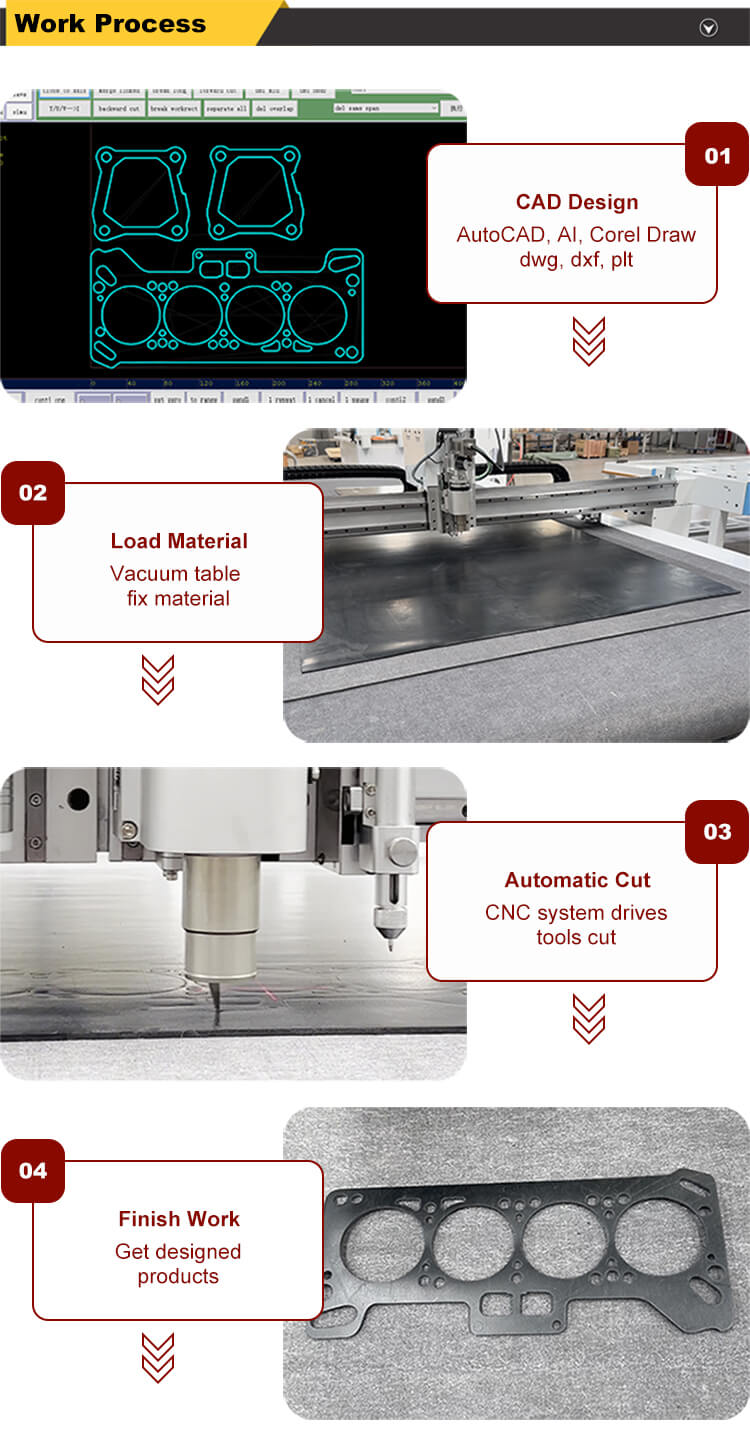
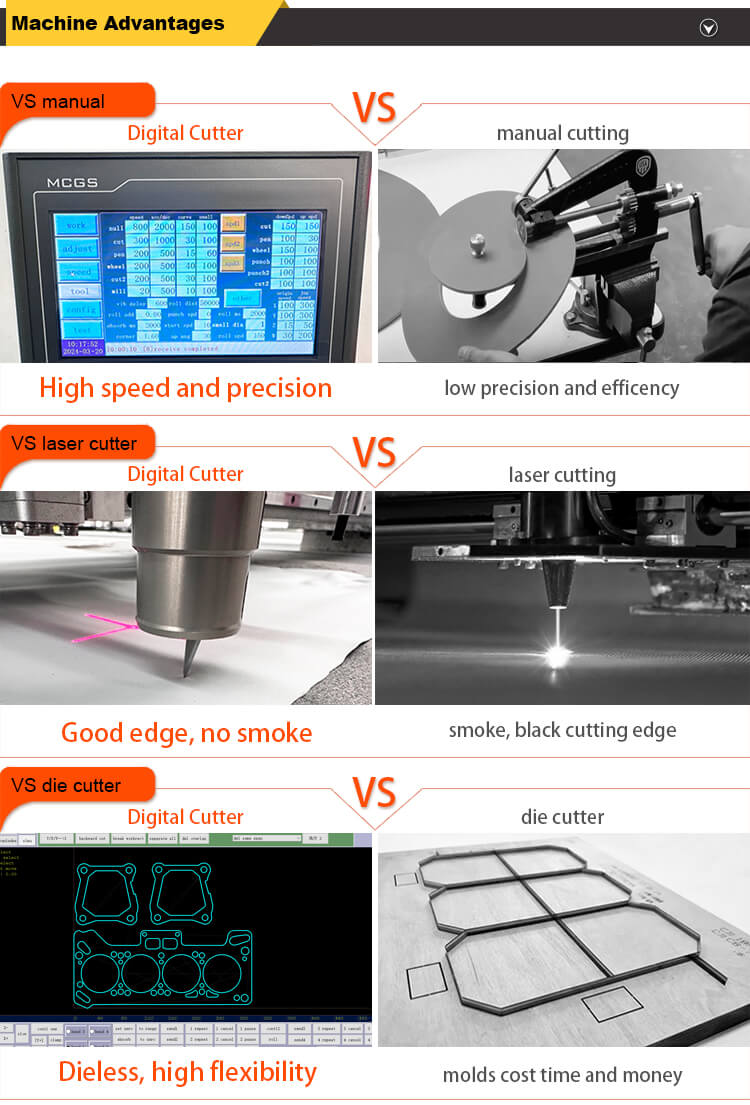
CNC die-less gasket cutting eliminates tooling cost entirely. A CNC gasket cutting machine reads a CAD drawing directly and cuts the gasket shape from rubber, PTFE, graphite, or non-asbestos sheet material with ±0.1mm accuracy — from file to first cut gasket in under 10 minutes, with no die to design, manufacture, or store. For gasket manufacturers handling custom orders, prototype work, or frequent design changes, this is a fundamental shift in how production economics work.
This guide explains how CNC die-less gasket cutting works, which materials it handles, how it compares to traditional die cutting, and what to look for when selecting a CNC gasket cutting machine.
The Problem with Traditional Die Cutting for Gaskets
Traditional gasket manufacturing relies on steel rule dies or punch dies — custom-made metal tools that stamp or punch the gasket shape from sheet material. This approach has served the industry for decades, but it carries structural limitations that become increasingly costly in modern manufacturing environments:
High tooling cost. A steel rule die for a standard industrial gasket costs around $500 depending on complexity. A punch die for a large flange gasket can cost $1,000. For a gasket manufacturer serving multiple industries with hundreds of different gasket specifications, the total die inventory represents a significant capital investment.
Long lead time for new designs. When a customer needs a new gasket design — a new flange size, a modified bolt pattern, a new material specification — the die must be designed and manufactured before the first gasket can be cut. This typically takes 2–4 weeks. In maintenance and repair situations, where a plant shutdown is waiting for a replacement gasket, this lead time is unacceptable.
Inflexibility for design changes. If a gasket design changes — even a minor modification to a bolt hole position — the existing die is obsolete and a new die must be manufactured. There is no way to modify a steel rule die; it must be remade from scratch.
High minimum order quantities. The die cost must be amortized across the production run. For a $1,000 die, cutting 10 gaskets means $100 of die cost per gasket — making small orders economically unviable. This forces customers to order more than they need, tying up capital in inventory.
Die storage and management. A gasket manufacturer with 500 active gasket specifications must store 500 die sets, track their condition, and manage their retrieval and replacement. This is a significant operational overhead.
CNC die-less cutting eliminates all of these problems simultaneously.
How CNC Die-Less Gasket Cutting Works
A CNC gasket cutting machine is a flatbed cutting system with an oscillating knife cutting head, a vacuum hold-down table, and a CNC controller that reads digital design files.
The Cutting Process
Step 1: Receive the CAD file.
The customer sends a CAD drawing of the gasket — DXF, DWG, AI, or similar format. No physical template or die is needed. If the customer does not have a CAD file, the gasket shape can be digitized from a physical sample or a paper drawing.
Step 2: Load the material.
The gasket sheet material (rubber, PTFE, graphite, non-asbestos, etc.) is placed on the cutting table. The vacuum system activates and holds the material flat and stationary.
Step 3: Nest the patterns.
The nesting software arranges the gasket shapes on the material sheet to maximize utilization. For standard rectangular sheets, this is straightforward. For irregular or partially used sheets, the software optimizes placement to minimize waste of expensive materials like PTFE and graphite.
Step 4: Cut.
The CNC cutting head follows the programmed paths, cutting all gasket shapes from the sheet. Cutting time for a standard industrial gasket (300mm diameter, 4mm thick rubber) is typically 30–90 seconds. A full sheet of gaskets can be cut in 5–15 minutes.
Step 5: Collect parts.
The cut gaskets are lifted from the table. The waste material (the sheet skeleton between gaskets) is removed separately.
Total time from file to first gasket: under 10 minutes. Compare this to 2–4 weeks for die manufacturing.
Materials Suitable for CNC Die-Less Gasket Cutting
CNC oscillating knife cutting is effective on all non-metallic gasket materials. The blade type and cutting parameters are adjusted for each material:
Thickness range: 0.5mm – 20mm (thicker with specialized blades)
Cutting characteristics: Rubber is elastic — it deforms under cutting pressure and springs back. The oscillating knife's high-frequency vibration minimizes the cutting force applied to the material, reducing deformation during cutting and improving dimensional accuracy.
Applications: General industrial sealing, automotive gaskets, HVAC seals, pipe flanges
Cutting characteristics: PTFE is soft and tends to deform under cutting pressure. The vacuum hold-down is critical for PTFE — without firm hold-down, the material shifts during cutting and dimensional accuracy suffers. The oscillating knife produces clean edges without the tearing or deformation that drag knives cause on PTFE.
Applications: Chemical processing, pharmaceutical, food processing, high-temperature sealing
Shilai's SL1610FG PTFE Gasket Cutting Machine is specifically configured for PTFE and other non-metallic gasket sheets, with the vacuum hold-down power and blade specification required for accurate PTFE cutting.
Graphite Sheet Gaskets
Materials: Flexible graphite sheet (pure graphite, graphite with metal insert)
Thickness range: 0.3mm – 3mm
Cutting characteristics: Graphite is brittle and generates fine dust during cutting. The oscillating knife produces less dust than rotary cutting tools, and the machine's vacuum system captures the majority of graphite dust at the source. The blade must be sharp — a dull blade causes edge crumbling on graphite.
Applications: High-temperature sealing, steam systems, petrochemical flanges, power generation
Shilai's SL6090FG Graphite Gasket Cutting Machine is designed for graphite and PTFE gaskets, with dust management and blade specifications optimized for these materials.
Cutting characteristics: Non-asbestos fiber gaskets are fibrous and can fray at cut edges if the blade is not sharp or the cutting parameters are not optimized. The oscillating knife's high-frequency action severs fibers cleanly, producing smooth edges without fraying.
Applications: General industrial flanges, automotive exhaust, medium-pressure sealing
Compressed Asbestos Fiber (CAF) Gaskets
Materials: Asbestos fiber sheet with rubber binder (where still in use)
Cutting characteristics: Similar to non-asbestos fiber. Note: asbestos cutting generates hazardous dust — the machine must be operated with appropriate dust extraction and personal protective equipment.
Cutting characteristics: Foam gaskets require the same compression-free cutting approach as foam packaging — the oscillating knife cuts without compressing the foam, maintaining the gasket's designed thickness and sealing performance.
Applications: Electronics sealing, HVAC duct sealing, automotive door seals
CNC Die-Less Cutting vs. Die Cutting: Full Economic Comparison
Factor
CNC Die-Less Cutting
Die Cutting
Tooling cost
$0
$500–$15,000 per die
Time to first part (new design)
Under 10 minutes
2–4 weeks
Minimum order quantity
1 piece
Typically 50–500+ pieces
Design change cost
$0 — update CAD file
New die required
Cutting accuracy
±0.1mm
±0.1–0.5mm
Material utilization
High — intelligent nesting
Fixed — die layout
Die storage requirement
None
Significant
Suitable for prototyping
✅ Yes
❌ No (die cost prohibitive)
Suitable for custom orders
✅ Yes
❌ Limited
Suitable for high-volume repeat orders
✅ Yes
✅ Yes (lower per-piece cost)
When CNC die-less cutting is clearly the better choice:
Custom gaskets (any size, any quantity)
Prototype and development work
Replacement gaskets for maintenance and repair
Production with multiple gasket specifications
Any situation where lead time matters
When die cutting may still be competitive:
Very high volume (100,000+ pieces) of a single, never-changing gasket design
Materials that are difficult for blade cutting (very hard rubber compounds)
For most gasket manufacturers, CNC die-less cutting is the economically superior choice across the majority of their product range.
Shilai CNC Gasket Cutting Machine Range
Shilai offers a complete range of CNC gasket cutting machines for different materials, sheet sizes, and production volumes:
Model
Working Area
Best For
Key Feature
SL6090FG Graphite Gasket Cutting Machine
600×900mm
Graphite, PTFE, small-batch custom
Compact, die-less, ±0.1mm
SL1610FG PTFE Gasket Cutting Machine
1600×1000mm
PTFE, rubber, non-asbestos sheets
Medium-format flatbed
SL1625FG Large-Format Asbestos Gasket Cutter
1600×2500mm
Full-size sheets, oil & gas, chemical
Large format, clean cutting
SL1610CG Auto-Feeding Gasket Cutter
1600×1000mm + conveyor
Rubber and silicone rolls
Auto-feed, continuous cutting
SL1625FGD Dual-Head Gasket Cutting Machine
1600×2500mm
High-volume production
Two independent cutting heads
All models feature die-less digital cutting from CAD files, ±0.1mm accuracy, and a 3-year warranty.
Industries and Applications
Oil, Gas, and Petrochemical
High-pressure flange gaskets for pipelines, valves, and pressure vessels. Typically graphite, PTFE, or spiral-wound constructions. CNC cutting handles the graphite and PTFE components with the precision required for high-pressure sealing.
Chemical Processing
Corrosion-resistant gaskets in PTFE and expanded PTFE for chemical flanges and reactor connections. The die-less capability is particularly valuable in chemical plants where process changes frequently require new gasket specifications.
Power Generation
Steam turbine gaskets, heat exchanger gaskets, and boiler connections. High-temperature graphite gaskets are the standard material. CNC cutting provides the dimensional accuracy required for reliable sealing in high-temperature, high-pressure steam systems.
Automotive Manufacturing
Engine gaskets, exhaust gaskets, and sealing components in rubber, non-asbestos fiber, and PTFE. Automotive gasket production combines high volume (where CNC cutting is efficient) with frequent model changes (where die-less capability eliminates retooling cost).
General Industrial Maintenance and Repair
Replacement gaskets for flanges, pumps, compressors, and heat exchangers across all industries. This is the application where die-less cutting provides the most dramatic advantage — a maintenance team can cut a replacement gasket from a CAD file in minutes, rather than waiting weeks for a die to be manufactured.
How to Get Started with CNC Gasket Cutting
Step 1: Identify your most common gasket materials and sizes.
This determines which machine model is appropriate — compact flatbed for small graphite and PTFE gaskets, large-format flatbed for full-size industrial sheets, auto-feed for rubber and silicone rolls.
Step 2: Prepare sample CAD files.
Send us DXF or DWG files for 3–5 representative gasket designs from your product range. If you do not have CAD files, we can digitize from physical samples.
Step 3: Request a free sample cutting test.
We will cut your gasket designs from your specified materials and send you the cut samples for dimensional verification and edge quality inspection.
Step 4: Evaluate the results.
Measure the cut gaskets against your design dimensions. Verify that the accuracy meets your application requirements. Inspect the edge quality for the sealing performance requirements of your applications.
CNC die-less gasket cutting is a method of manufacturing gaskets directly from CAD drawings using a CNC oscillating knife cutting machine, without any tooling dies. The machine reads the gasket geometry from a digital file and cuts it from sheet material with ±0.1mm accuracy — from file to first gasket in under 10 minutes, at zero tooling cost.
What gasket materials can a CNC cutting machine handle?
CNC oscillating knife cutting machines can handle all common non-metallic gasket materials: rubber (natural, EPDM, nitrile, silicone, neoprene), PTFE (virgin, filled, expanded), graphite sheet, non-asbestos fiber sheet, compressed asbestos fiber, and foam gasket materials (EPDM foam, silicone foam).
How accurate is CNC gasket cutting?
Shilai CNC gasket cutting machines achieve ±0.1mm cutting accuracy, which meets the dimensional requirements for industrial sealing applications including oil and gas, chemical processing, and power generation.
How quickly can I get a custom gasket cut with a CNC machine?
From receiving a CAD file to cutting the first gasket takes under 10 minutes. This compares to 2–4 weeks for die manufacturing. For maintenance and repair applications where equipment is shut down waiting for a replacement gasket, this speed advantage is critical.
Is CNC die-less cutting more expensive per gasket than die cutting?
For small to medium production volumes, CNC die-less cutting has a lower total cost per gasket because there is no die cost to amortize. For very high volumes of a single, unchanging gasket design, die cutting may have a lower per-piece cutting cost — but the die cost, storage cost, and inflexibility must be factored into the comparison.
Can CNC cutting handle gaskets with complex shapes?
Yes. CNC cutting handles any shape that can be defined in a CAD file — including complex bolt hole patterns, irregular outer profiles, and gaskets with internal cutouts. Complex shapes that would be expensive or impossible to die-cut are straightforward for CNC cutting.
Jinan Shilai Technology Equipment Co., Ltd. is a leading manufacturer specializing in the R&D and production of intelligent CNC oscillating knife cutting machines. We provide advanced digital flatbed cutting solutions for packaging, automotive, advertising, and textile industries worldwide.
This website uses cookies and similar technologies (“cookies”). Subject to your consent, will use analytical cookies to track which content interests you, and marketing cookies to display interest-based advertising. We use third-party providers for these measures, who may also use the data for their own purposes.
You give your consent by clicking "Accept all" or by applying your individual settings. Your data may then also be processed in third countries outside the EU, such as the US, which do not have a corresponding level of data protection and where, in particular, access by local authorities may not be effectively prevented. You can revoke your consent with immediate effect at any time. If you click on "Reject all", only strictly necessary cookies will be used.