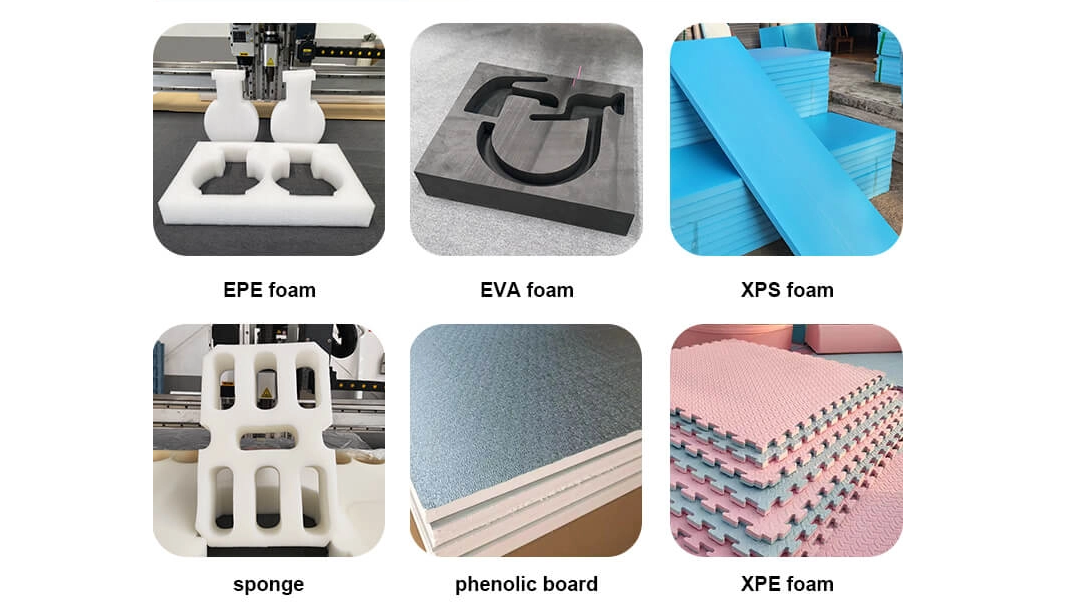
In the diverse world of manufacturing, one size rarely fits all. The market is flooded with various types of foam cutting machines, each boasting unique technical features and ideal applications. For a business owner, selecting the wrong equipment can mean production bottlenecks or wasted investment.
Are you working with soft sponge for furniture or rigid XPS for insulation? Do you need simple slicing or complex 3D milling? This article provides a detailed technical comparison of the major foam cutting technologies, guiding you to the solution that best fits your specific production goals.
1. The Main Types of Foam Cutting Machines
Understanding the specific strengths of each machine type is the first step in making an informed decision.
1.1 Automatic PU Foam Cutting Machine
Scope: Primarily designed for soft materials like Polyurethane (PU) sponge, memory foam, and latex.
Tech Features: These machines typically use a high-speed oscillating knife. They are known for their ability to compress and cut soft materials without deformation.
Advantage: Ideal for the furniture and bedding industry (sofas, mattresses) due to high speed and clean, dust-free edges.
1.2 CNC XPS Foam Cutting Machine
Scope: Specialized for rigid extruded polystyrene (XPS) used in construction and insulation.
Tech Features: Often utilizes specialized blades or hot wire technology controlled by CNC systems to glide through dense, rigid foam.
Advantage: Delivers smooth, sealed edges essential for thermal insulation panels, ensuring high precision for interlocking parts.
1.3 Foam Cutting Machine with Router
Scope: The most versatile option for creating 3D shapes, prototypes, and packaging inserts with varying depths.
Tech Features: Combines a cutting knife with a high-speed milling spindle (router). This allows the machine to not just cut through the material, but to carve into it (engraving/pocketing).
Advantage: Perfect for packaging that requires recesses for products, or for artistic 3D modeling.
1.4 Digital EPS Foam Cutting Machine
Scope: Focused on Expanded Polystyrene (EPS/Styrofoam), widely used in protective packaging and architectural moldings.
Tech Features: heavy-duty structures designed to handle large blocks of EPS.
Advantage: Capable of processing large volumes of lightweight material rapidly, making it a staple in the logistics packaging sector.

2. Technical Comparison: A Deep Dive
Let’s compare these technologies across four critical dimensions.
2.1 Cutting Precision
Oscillating Knives (PU/Digital Cutters): Offer the highest precision (typically ±0.1mm). Because there is no heat involved, there is no material shrinkage, ensuring the cut part matches the CAD drawing exactly.
Routers: High precision for depth and 3D detailing but generate more dust.
2.2 Degree of Automation
Modern foam cutting machines have moved beyond manual operation.
High Automation: Automatic PU and Digital EPS cutters often feature conveyor belt systems for continuous loading and unloading, making them ideal for mass production.
Standard Automation: Basic CNC models may require manual sheet loading but still offer fully automated cutting paths.
2.3 Material Compatibility Matrix
Machine Type | Soft Foam (PU/Sponge) | Rigid Foam (XPS/EPS) | Rubber/Gaskets | 3D Milling |
Auto PU Cutter | ⭐⭐⭐⭐⭐ | ⭐⭐ | ⭐⭐ | ❌ |
CNC XPS Cutter | ⭐⭐ | ⭐⭐⭐⭐⭐ | ⭐ | ❌ |
Router Cutter | ⭐⭐⭐ | ⭐⭐⭐⭐ | ⭐⭐⭐ | ⭐⭐⭐⭐⭐ |
Digital EPS Cutter | ⭐⭐ | ⭐⭐⭐⭐⭐ | ⭐ | ❌ |
2.4 Cost-Effectiveness
Initial Investment: Machines with Routers or complex Conveyor systems generally have a higher upfront cost.
Operational Cost: Oscillating knife cutters have low operational costs (blades are cheap and durable).
3. Key Factors for Choosing the Best Equipment
How do you make the final choice? Consider these three pillars.
3.1 Production Needs
Volume: For high-volume, continuous production (e.g., 500 mattresses a day), an automated conveyor system is non-negotiable.
Complexity: If you need to make complex 3D molds or packaging with varying depths, a machine with a router is the only logical choice.
3.2 Technical Support
The machine is only as good as the support behind it. Ensure your supplier provides:
Remote troubleshooting capabilities.
Readily available spare parts (blades, motors).
Comprehensive software training.
3.3 User Feedback
Look for case studies or testimonials in your specific industry. A machine that works wonders for a mattress factory might not be suitable for an insulation panel manufacturer.
Conclusion
Selecting the right foam cutting machine is a balance between your material requirements, production volume, and budget. While PU cutters excel in soft comfort materials, XPS and EPS cutters dominate the construction and packaging sectors.
By aligning the technical features discussed above with your business goals, you can invest in equipment that not only meets your current needs but drives future growth.
Still unsure which machine fits your production line?Contact our engineering team today. We will analyze your materials and production goals to recommend the perfect cutting solution.

Frequently Asked Questions (FAQ)
Q: Can a router machine cut soft sponge?
A: It is possible, but not ideal. Routers spin at high speeds which can tear very soft foams. An oscillating knife is far superior for soft sponge as it slices cleanly without tearing.
Q: What is the main advantage of a digital cutter over a manual die cutter?
A: Flexibility. A digital cutter requires no physical dies (molds). You can change the cutting shape instantly by updating the file, making it perfect for custom orders and prototyping.
Q: Which machine is best for making packaging inserts?
A: If the inserts are simple 2D shapes, a standard Digital Foam Cutter is best. If the inserts require different depths (pockets) for accessories, a Foam Cutting Machine with a Router is required.